Drawing gender diversity in the Journal of American Folklore
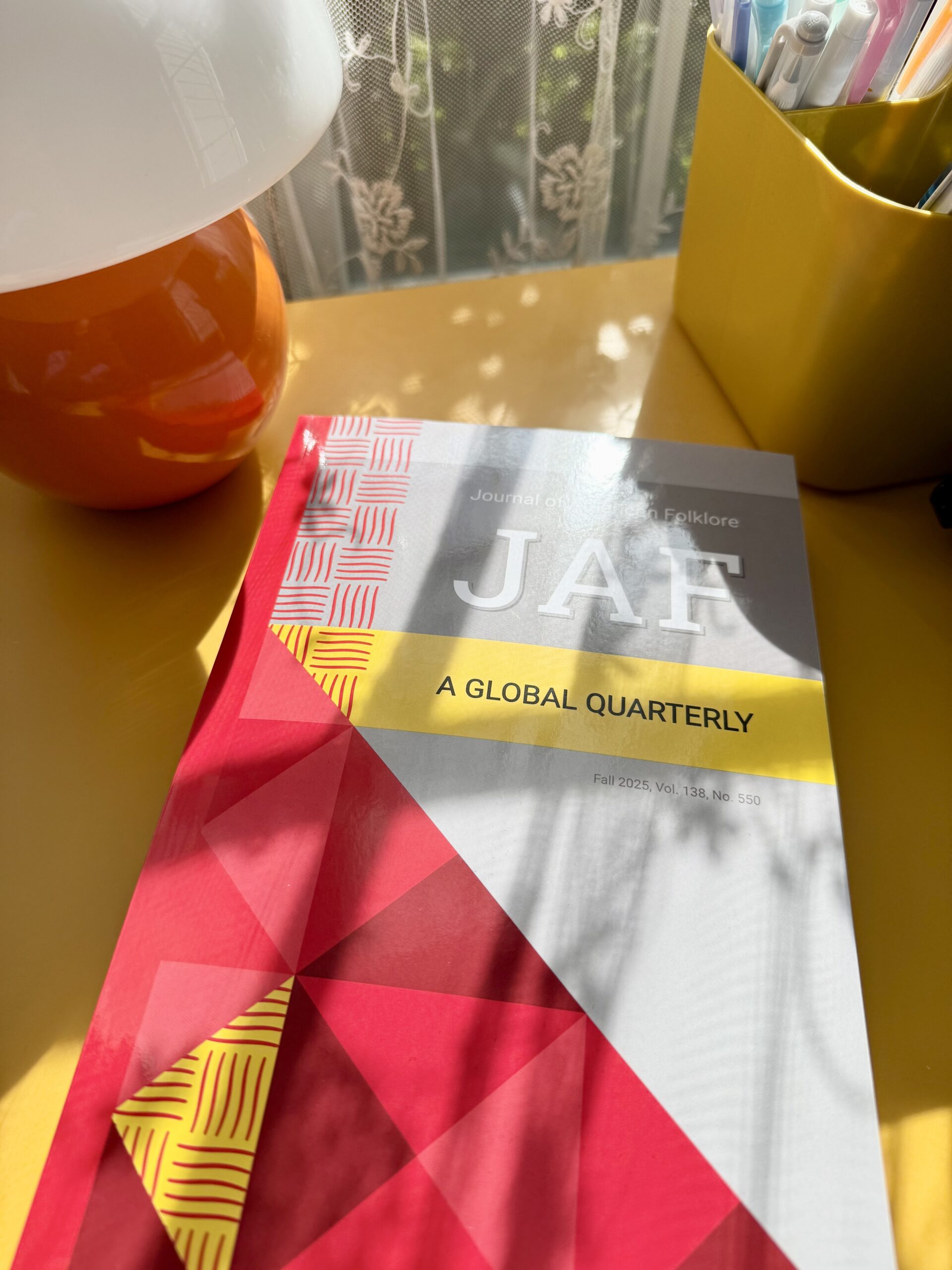
Look what arrived in the mail today! Thanks to the careful stewarding of the series editor and the Journal of American Folklore editorial team, my comic piece about how to draw queer, trans and other bodies in comics is at last out in print. You can even read the whole thing here at Project Muse.
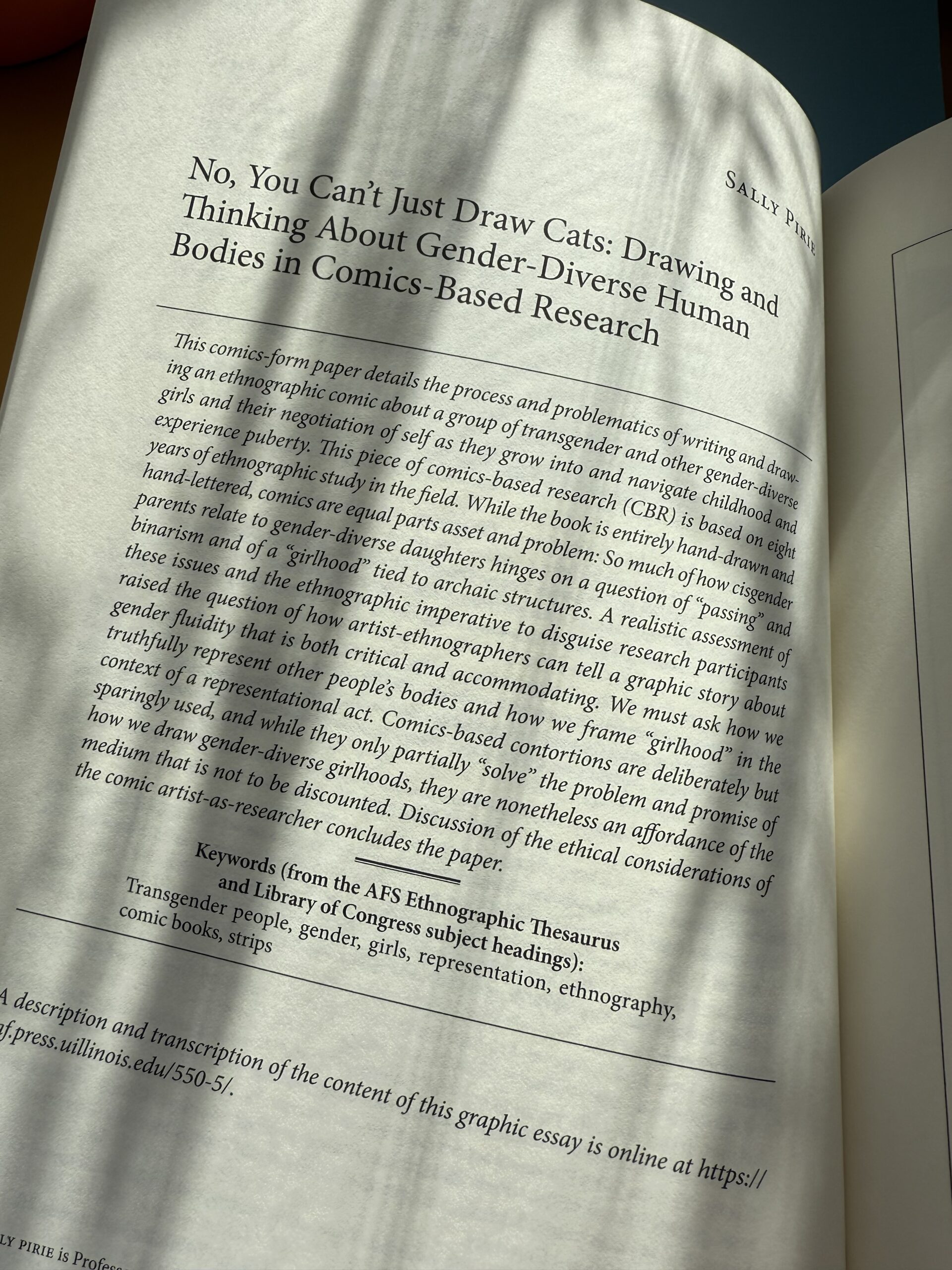
Pirie, S. C. (2025). No, you can’t just draw cats: Drawing and thinking about gender-diverse human bodies in comics-based research. Journal of American Folklore, 138 (550), 444-57.
The editors write,
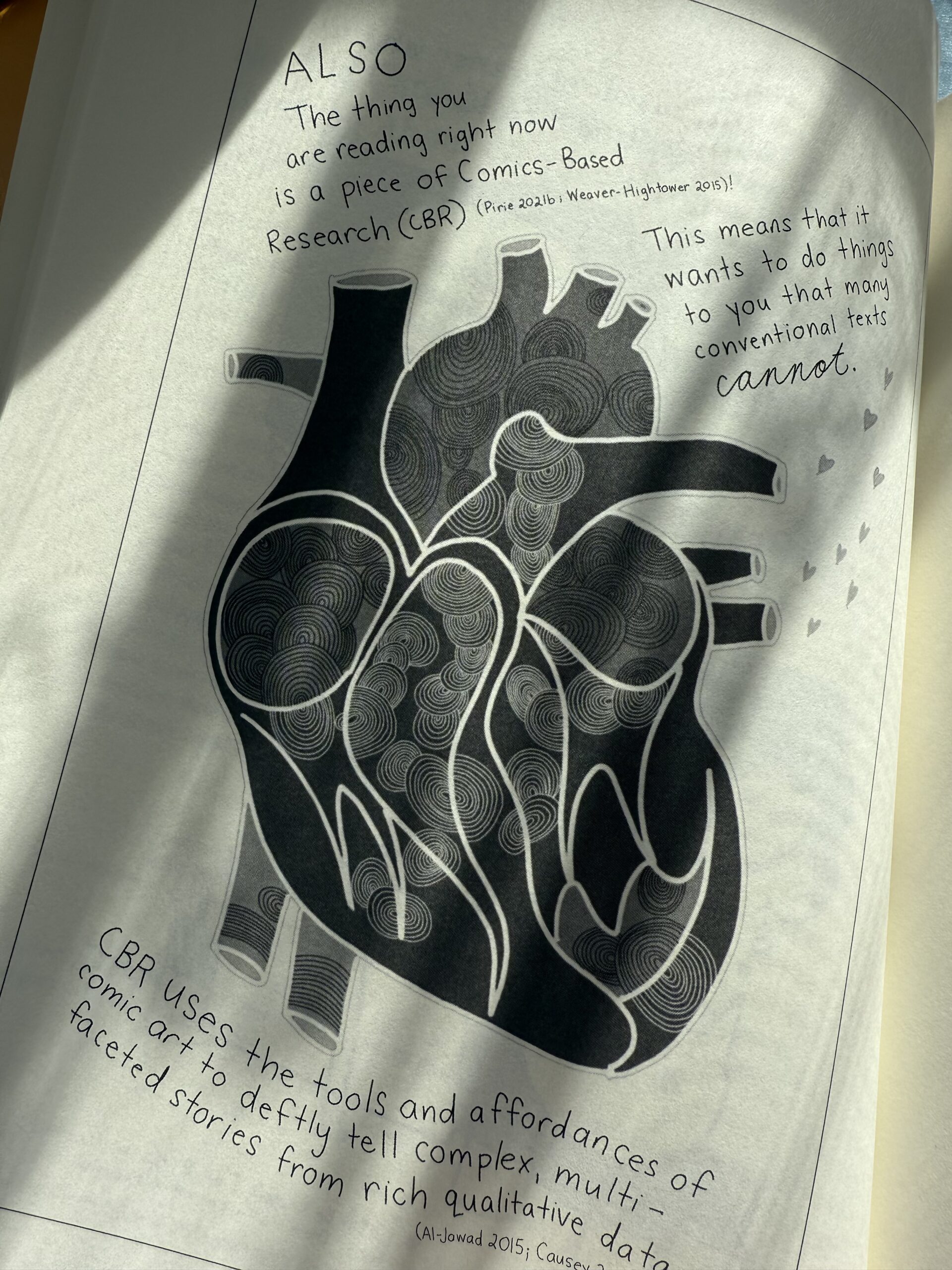
“In this issue, Sally Pirie explores the challenges of representation and anonymization in her work with transgender young people (2025). In her ethnographic comic contribution, Pirie reviews ways in which her efforts to represent transgender young people bumped up against their own perspectives on what being transgender meant to the, how they expressed– or saw themselves expressing–their identities, how their parents saw them–or wanted them to be seen–and the ways Pirie rendered them. …Pirie is a strong CBR advocate and the founder of the CBR Lab at the University of Massachusetts Amherst. In a recent article, ‘Kapow! Comics-Based Methods as Necessary Shimsy in Educational Research,’ Pirie employs the medium of comics to explore the rationale and methods of CBR and the value they bring to qualitative–and specifically ethnographic–research. Two key points made by Pirie regarding the value of comics in ethnography include the generative nature of comics creation when applied to the analysis of data (2023, p. 14) and the way comics, by their very natre, emphasize transparency and reflexivity in representation. Teresa Mares and Andy Kolovos have speculated on this idea: ‘What are the implications of drawing in relation to reflexivity and subjectivity? Due to the long-standing cultural perceptions of the subjectivity of visual art, is drawing innately reflexive in ways that differ from other modes of ethnographic representation–including text?’ (2021, p. 216). Pirie’s statement provides a direct answer: In comics, the author’s ‘voice is explicit’ (2023, p. 13). A third key point from Pirie relates to an emotive aspect of comics, the ‘real subversive power of in whimsy and delight’ (2023, p. 31). Pirie’s notion of ‘whimsy’ relates to the affective experiences of both the cartoonist and the reader” (p. 399-400).
“Folklore, Comics and Graphic Storytelling: Introduction” Erin Kathleen Bahl and Andy Kolovos
There are so many amazing contributions to this special, probably the best and most important part is the brilliant editorial introduction from Andy and Erin. They lay out in clear terms the contributions of comics to how we understand and think about folklore and the world around us before closing their powerful remarks with the admonition: “Be joyful. Make comics” (p. 400).
Here’s the official JAF release:
The JAF editorial team is pleased to announce the release of the 2025 Fall issue of JAF: A Global Quarterly (v. 138, no. 550), a special issue on “Folklore, Comics, and Graphic Storytelling.” Curated by guest editors Erin Kathleen Bahl and Andy Kolovos, this issue is groundbreaking in its combination of scholarly essays, creative non-fiction, pedagogical strategies, and public-facing pieces.
The contributors, who include scholars, educators, students, activists, and archivists, offer an inspiring mix of text and images that underscore the value and potential of graphic storytelling in folklore and allied fields for academic and non-academic audiences.
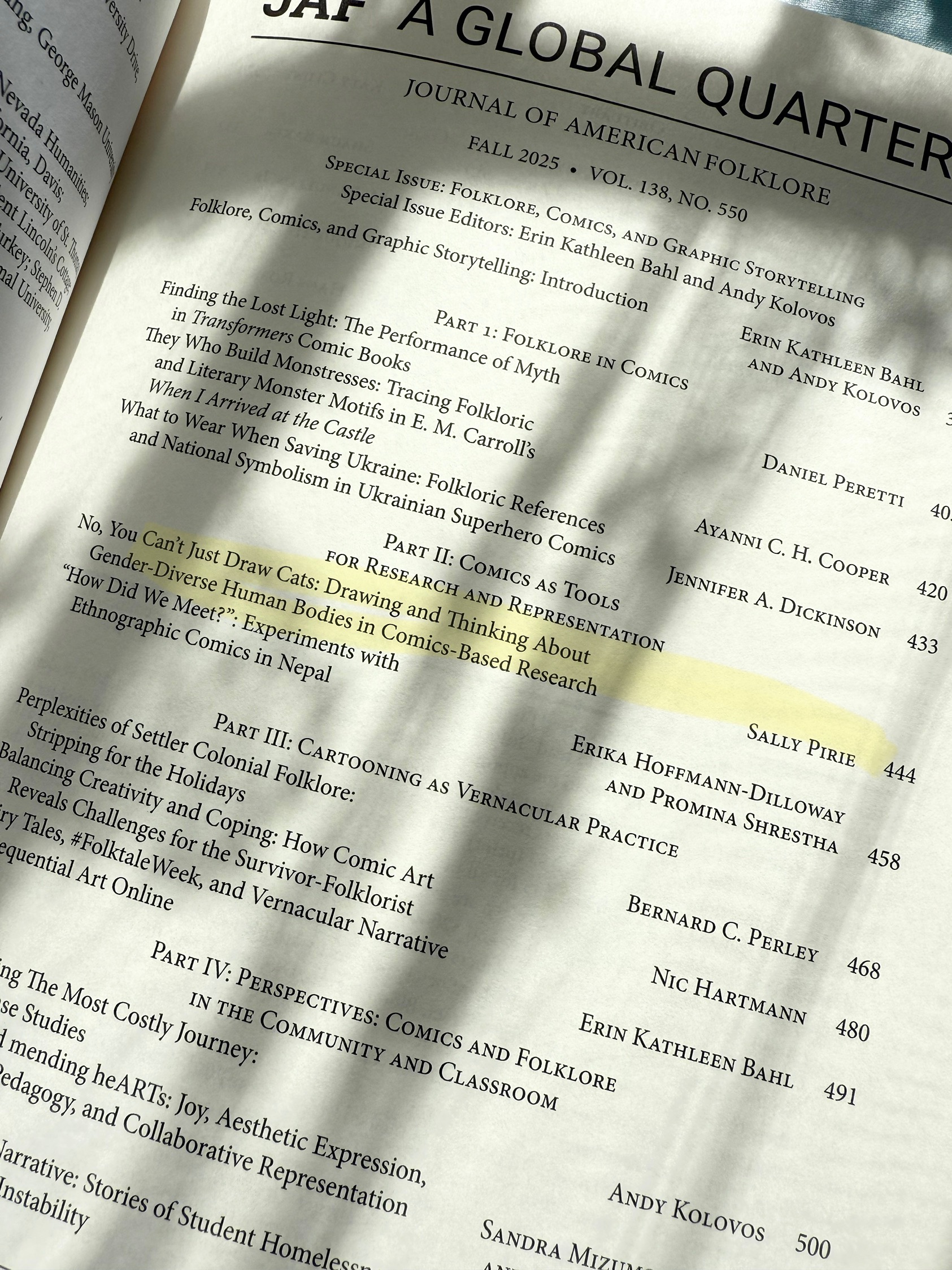
Special Issue: Folklore, Comics, and Graphic Storytelling
Special Issue Editors: Erin Kathleen Bahl and Andy Kolovos
Folklore, Comics, and Graphic Storytelling: Introduction, by Erin Kathleen Bahl and Andy Kolovos
Part 1: Folklore in Comics
Finding the Lost Light: The Performance of Myth in Transformers Comic Books, by Daniel Peretti
They Who Build Monstresses: Tracing Folkloric and Literary Monster Motifs in E.M. Carroll’s When I Arrived at the Castle, by Ayanni C.H. Cooper
What to Wear When Saving Ukraine: Folkloric References and National Symbolism in Ukrainian Superhero Comics, by Jennifer A. Dickinson
PART II: Comics as Tools for Research and Representation
No, You Can’t Just Draw Cats: Drawing and Thinking about Gender Diverse Human Bodies in Comics-Based Research, by Sally Pirie
“How Did We Meet?’: Experiments with Ethnographic Comics in Nepal, by Erika Hoffmann-Dilloway and Promina Shrestha
PART III: Cartooning as Vernacular Practice
Perplexities of Settler Colonial Folklore: Stripping for the Holidays, by Bernard C. Perley
Balancing Creativity and Coping: How Comic Art Reveals Challenges for the Survivor-Folklorist, by Nic Hartmann
Fairy Tales, #FolktaleWeek, and Vernacular Narrative Sequential Art Online, by Erin Kathleen Bahl
PART IV: Perspectives: Comics and Folklore in the Community and Classroom
Continuing The Most Costly Journey: Two Case Studies, by Andy Kolovos
rending and mending heARTs: Joy, Aesthetic Expression, Creative Pedagogy, and Collaborative Representation, by Sandra Mizumoto Posey and Cricket Malament
Changing the Narrative: Stories of Student Homelessness and Housing Instability, by Kacy McKinney
Obituary
Bernard L. Herman (1951-2024), by Katy Clune
Book Reviews
Haunting and Hilarious Fairy Tales (Bradt and Zipes), by Shaun Baker
Afro-Atlantic Catholics: America’s First Black Christians (Dewulf), by Jorge M. Banuelos, Jr.
Getting Something to Eat in Jackson: Race, Class, and Food in the American South (Ewoodzie Jr.), by Dominique HazzardDancing with Life: Recontextualizing Mexican Masks (Shlossberg, et al.), by Hans Roskamp
You can check it out here!