I love my CHC students, so I was thrilled when Dean Mari Castañeda asked me to give this year’s Induction Ceremony Keynote. Seriously, fangirling. I have been teaching in the honors college for a few years under Dean Castañeda’s leadership and it has been truly transformative. If you do not know her, look her up and see for yourself the brilliant work she is doing.
While I thought that the best parts of the ceremony were the outstanding student speaker, Daniel Nguyen, and the UMass pep band–hands-down–lots of nice people asked me for a copy of my remarks. So here they are with all the links and cites and stuff. Enjoy, and welcome to the new school year!
Pirie, S. (2025, August 29). Faculty keynote lecture. University of Massachusetts Commonwealth Honors College Induction Ceremony, Amherst MA.
Thanks to everyone for having me, and especially to Dean Castañeda for inviting me to speak with you all today. The commonwealth Honors program has a very special place in my heart, and I’m overjoyed to be able to be a little part of the welcome wagon today.
I’m Sally Pirie and I’m Professor of Child and Family Studies in the College of Education here at UMass but I’m also the director and master artist of the Comics-Based Research Lab, where we help students and faculty do research using comics—drawing them, reading them, analyzing them, you-name-it.
Comics-based research is a kind of arts-based research (where we use the different modalities of the arts to do all kinds of things at all the stages of research) and that’s what I teach here in the honors college. My discovery series seminar is about trying out different kinds of arts-based research and thinking about how you might do an arts-based final project or thesis. I had one student years ago who crocheted a building. It was fantastic! And while not everyone wants to crochet a building for their honors thesis, I believe that understanding and experiencing the arts, and oneself as an artist, can really help open up our minds and selves to do better, sharper, more creative, nonconformist and therefore powerful research and thinking.
And I am not going to lie. These are tough times we find ourselves in. And for tough times we need art. Because art creates the conditions by which we all might become more fully human, and creation—artistic, intellectual, athletic—all of it, contradicts destruction. But even though I spent almost 45 minutes when writing this lecture trying to find deep, intense quotes about how art can lift our souls, etc. I really am here to talk to you today about something a little bit different but no less important.
I’m speaking to you today as a person who draws funny pictures for a living. I’m the funny kind of cartoonist. I trade in fables of joy and whimsy and delight and subversion (because making people laugh is resistance, as George Orwell said, “every joke is a custard pie—whatever is funny is subversive”). So, as I look at what is upon us, as scholars, as people, as you all as you embark upon this adventure, I wanted to give you three pieces of advice that are all rooted in the kind of art that delights. It is the advice I give my daughters, my friends, and myself when I look in the mirror and take that deep breath.
First, I want you to SEEK WHIMSY. As a career artist, I can tell you that art is about discipline, absolutely, but it is also the place where we must value whimsy. There should be joy in the work. Work is hard. Of course it is. I drew for 12 hours today and may never bend at the waist completely again—but, as a nun once told me, the trick is to find whimsy in it. I have a friend who is a professional fiber artist who, on her lunch breaks, crochets naughty human body parts and attaches them to public fenceposts all over a major metropolitan area. Because she can. Because they delight. And this isn’t me being pollyannaish: “Whimsy,” writes Joanna Mann, “provides a glimmer of hope that other ways and worlds are possible if we allow ourselves to be nourished by the energy their surprise affords” (2014 p. 71). Or as Petra Rethman (2021) writes, these are the “Kantian categories of beauty or the sublime, because they point out the pleasure and joy that attaches itself to the riotous, irreverent, sprawling, vernacular, ubiquitous, and cheap” (n.p.). This is the stuff hope is made of, folks. The world is full of both crocheted naughty bits and also glimmers of sublime hope if you will only take the time to see it.
Second, and relatedly, I want you to SLOW DOWN AND SEE. The best way to do this is to keep a sketchbook—even if you think you cannot draw, or you have no interest in drawing and would prefer to make diagrams or collages or shapes out of masking tape. It all works. Van Gogh called his sketchbook his witness, where he learned to see instead of look. Unlike just looking, seeing is deliberately slowing down in a world that moves way too fast (and tricks you into thinking that you must also move fast). Imagine the time it takes to look at something versus the time it takes to draw a portrait—to really see another person. This is no quick snap. This is drawing to see. It slows the overwhelm and acts against the contemporary imperative to move fast and break things and also trains us to trust our own seeing in a world that seeks to erode that trust by telling us we did not see, that nothing is real, that we are powerless, that witness is futile. Developing and being able to trust your seeing is the antidote. But it requires practice. If you sketch things from life for five minutes every day your life will improve. I promise you this.
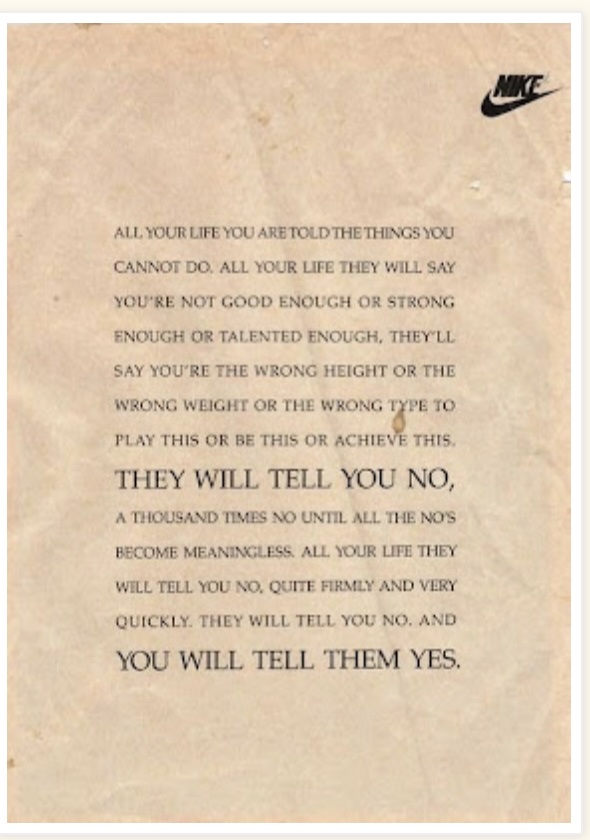
Third, and lastly, I want you to SAY YES. To new things, to emotional and intellectual risks, to opportunity, to hope, to failure, and mostly to yourself. I was a person who was told no but kept saying yes. I was born in another country to working class parents who may not totally get why I am still in school. I was told by a professor at my very fancy liberal arts college that a person like me doesn’t have the intellectual abilities to do more than labor. I have never been to art school (and was rejected from lots of art schools) and then I went on to win the Charles Schulz. I was told my work was cute but I could not seriously hope to draw pictures and be a serious academic and social scientist—but that was seven books ago. The haters are out there, the road is steep, and the odds are not great, but I am here to tell you that you can do this thing. Begin by telling yourself YES. To quote my favorite old Nike ad that still hangs in my office under a picture of Judith beheading Holofernes, “They will tell you no. A thousand times no until all the no’s become meaningless. All your life they will tell you no. Quite firmly and very quickly. They will tell you no. And you will tell them yes.” And do you know where you get the nerve to keep answering back yes? Surprise! It’s art! Art provides us with alternative furniture for our minds to fortify a possible world. I think people spend a lot of time telling us all that drudgery is our lot in life, that we should just work harder, that we are not stardust, that our dreams are not attainable and that we must settle for being sad, or bored, or influencers, toiling endlessly in the phantasmagoria.
But they didn’t have art. They couldn’t see. They didn’t say yes. You can.
Here are some citations, and also some other things you might like to read on this and related subjects:
Al-Jawad, Muna. (2015). Comics are research: Graphic narratives as a new way of seeing clinical practice. Journal of Medical Humanities 36, 369–374. https://doi.org/10.1007/s10912-013-9205-0
Barnes, Robert. (2015). Teaching art to young children. Routledge.
Barry, Lynda. (2019). Making comics. Drawn and Quarterly.
Bonanno, Lisa. (2019). Drawing as a mode of translation. American Anthropologist. https://www.americananthropologist.org/ethnographic-storytelling/bonanno-drawing-as-a-mode-of-translation Accessed 10/29/24
Bray, Zoe. (2013). Anthropology/ethnography and naturalist/realist painting: Parallels in the ways of seeing and understanding the world. In Michael Pearce (Ed.), The real snake: Proceedings of the Representational art conference 2012, 141-50. CreateSpace Independent Publishing Platform.
Cahnmann-Taylor, Melisa and Siegesmund, Robert. (2018). Introduction. In Melisa Cahnmann-Taylor and Robert Siegesmund, (Eds)., Arts-based research in education: Foundations for practice, 1-11.
Causey, Andrew. (2017). Drawn to see: Drawing as an ethnographic method. University of Toronto Press.
Emberly, Ed. (2006). Ed Emberly’s drawing book: Make a world. LB Kids.
Gormally, Cara. (2024). Comics-based non-fiction scholarship. An invited lecture for the Comics-Based Research Lab, University of Massachusetts at Amherst, October 29.
Hamdy, Sherine, Coleman Nye, Sarula Bao, and Caroline Brewer. (2017). Lissa: A story about medical promise, friendship and revolution. University of Toronto Press.
Hammer, Ralph. (2017). Stop taking pictures and start drawing! https://ralphammer.com/stop-taking-pictures-and-start-drawing/
Jain, Lochlan. (2022). Companion images. Fieldsites, July 28. https://culanth.org/fieldsights/companion-images accessed 10/20/2024.
Kashanipour, Jasamin. (2021). The gradual gaze: Drawing as a practice of ethnographic description. Anthropology and Humanism, 46 (1), 81-94. https://doi.org/10.1111/anhu.12325
Kent, Corita. (1992). Immaculate Heart College Art Department Rules. www.corita.org
Kuschnir, Karina. (2016). Ethnographic drawing: Eleven benefits of using a sketchbook for fieldwork. Visual Ethnography, 5 (1), 103-134. http://dx.doi.org/10.12835/ve2016.1-0060
Kuttner, Paul J., Marcus B. Weaver-Hightower and Nick Sousanis. (2021). Comics-based research: The affordances of comics for research across disciplines. Qualitative Research, 21 (2), 195-214. https://doi.org/10.1177/146879412091884
Mann, J. (2015). Toward a politics of whimsy: Yarn bombing the city. Area, 47(1), 65–72. https://doi.org/10.1111/area.12164
Mariner, Kathryn A. and Cardona, Miguel A. (2021). Just visiting: Curious ethnography, intentional design, and collaborative art. Fieldsites. https://culanth.org/fieldsights/just-visiting-curious-ethnography-intentional-design-and-collaborative-art
Nussbaum, Martha. (1995). Poetic justice: The literary imagination and public life. Beacon Press.
Perumal, Shahdab. (2024). ‘Bearing witness’ in the field. Ethnomarginalia, August 8. Retrieved March 6, 2025 from https://ethnomarginalia.com/2024/08/28/bearing-witness-in-the-field/
Pirie [as Galman], Sally C. (2021a). Follow the headlights: On comics based data analysis. In Charles Vanover, Paul Mihas and Johnny Saldaña, (Eds.). Analyzing and Interpreting Qualitative Data: After the Interview, 28-37. London: SAGE.
Pirie [as Galman], Sally C. (2021b). Yes and. American Anthropologist. https://www.americananthropologist.org/online-content/insights-forms-of-engagement.
Pirie, Sally C. (2023). Kapow! Comics-based methods as necessary whimsy in educational research. In Jason DeHart and Peaches Hash. (Eds). Exploring the human story: Arts-based approaches to qualitative inquiry in educational studies, 1-16. Taylor and Francis.
Pirie, Sally C. (2025). Barbie the girl-maker: Transgender girls, their mothers, and The Whole Barbie Thing. In Rebecca Hains and Emily Aguilo-Perez, (Eds), Barbie in the Media: The Cultural Impact of Mattel’s Celebrity Doll, 180-220. Palgrave-MacMillan.
Ramos, Manuel Joao. (2004). Drawing the lines: The limitations of intercultural ekphrasis. In Sara Pink, Lazlo Kurti and Ana Isabel Alfonso, (Eds.). Working images: Visual research and representation in ethnography, 147-161. Routledge.
Sohini, Kay. (2022). On graphic scholarship: A conversation with Nick Sousanis. The Comics Grid: Journal of Comics Scholarship, 12 (1), 1-16. DOI:https://doi.org/10.16995/cg.8773
Taussig, Michael. (2011). I swear I saw this: Drawings in fieldwork notebooks, namely my own. University of Chicago Press.
Theodossopoulos, Dimitrios. (2022). Introduction: Graphic ethnography on the rise. Fieldsites, July 28. https://culanth.org/fieldsights/introduction-graphic-ethnography-on-the-rise
Weaver-Hightower, Marcus B. (2015). Losing Thomas and Ella: A father’s story (a research comic). Journal of Medical Humanities, 38, 215-230. DOI: 10.1007/s10912-015-9359-z
Williams, Margery. (1922). The velveteen rabbit. George H. Duran Company.