A NEW BOOK STRAIGHT FROM THE OG QUEEN TO ALL OF YOU
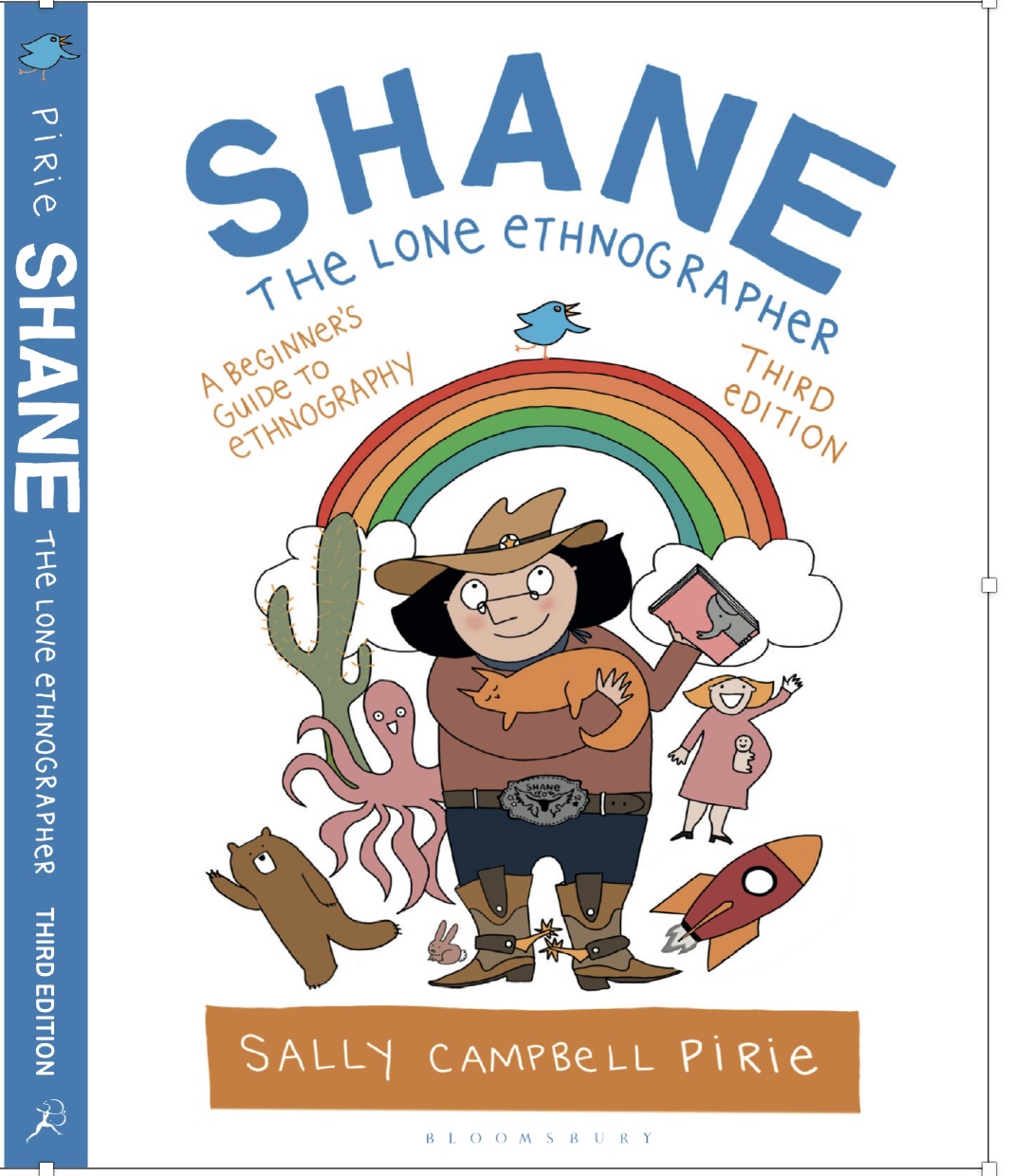
It’s always exciting when a new book comes out, and even though I finished drawing the third edition of Shane about a month ago, I got the complete cover proofs today and now it feels like it’s really real. And no matter how many books I’ve written at this point (I think 9? 10? Maybe more? Why don’t I know this number off-hand?) it is always so exciting to see the new cover all nice and bright and shiny. And the production team at Bloomsbury really did a great job here. Look! It is so gorgeous. If I do say so myself.
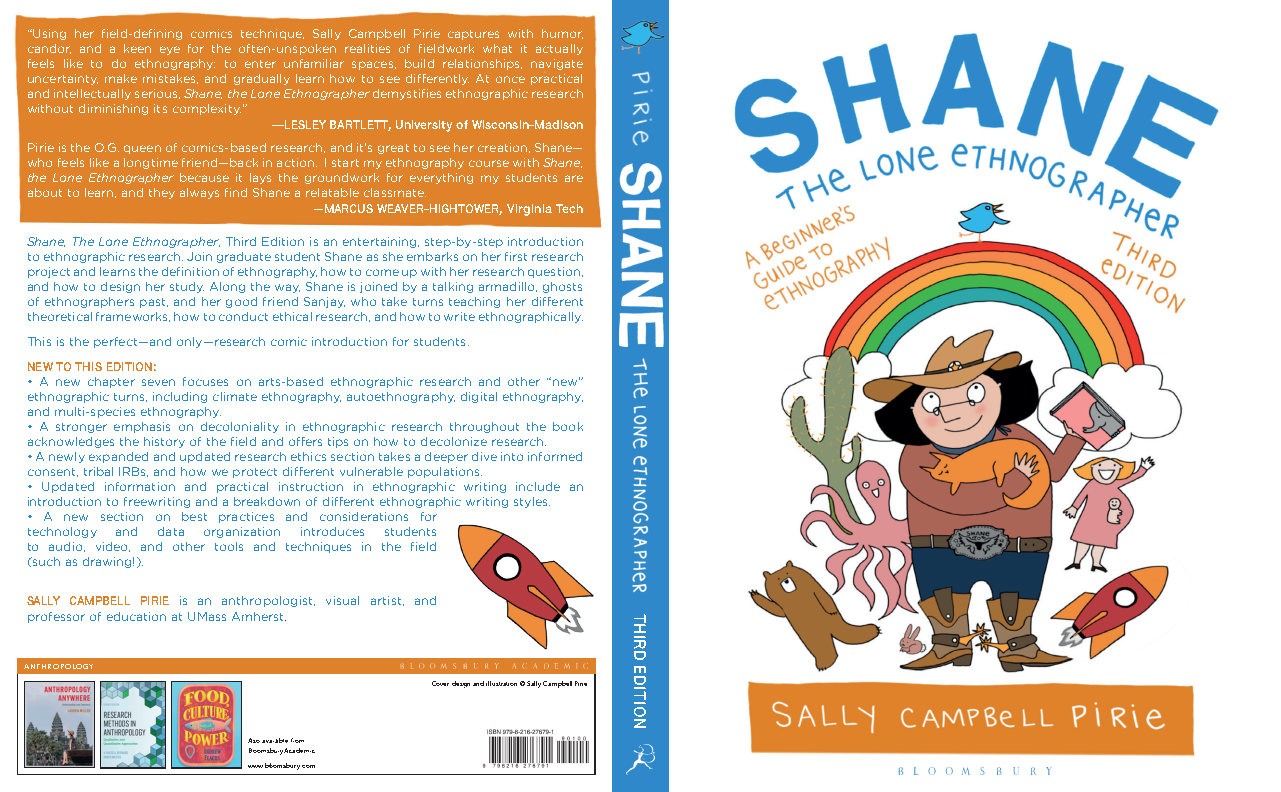
For those of you wondering what goes into writing a third edition of a book, let me tell you it is more than a few edits and back-on-the-shelf-it-goes. While I can’t speak to straight scholarship, I can tell you that in the case of comics-based work it means writing and drawing a completely new book. Every single line has been redrawn and basically everything is new.
Here’s the book’s introduction as a very fancy preview just for you, below, in very helpful purple formatting:
And after you read it, when you feel as though you MUST own your very own copy of this luminous text, you can preorder it here! I keep the price astonishingly low for an academic text because, well, that’s what OG Queens do.
It has been just over 20 years since I finished the first edition of this book. A lot has happened since then— my children were born and have (mostly) fledged and left the nest, many more Shane books have been published, I was tenured and promoted, I’ve become a better scholar and artist, comics-based research has become a thing, and I’ve developed cherished friendships with colleagues all over the world. It has been wonderful.
And, of course, the world is a very different, much more somber and challenging place than it was in 2006 when I first started drawing Shane. The planet is in crisis, the United States is in the grip of political chaos, higher education is facing unimaginable challenges, and vulnerable people everywhere are in more danger than ever before. Some might argue that now is not the time for a seemingly light, perhaps even whimsical comic treatment of the scientific endeavor.
But, as I have argued time and time again, there is nothing we need more right now than the comic approach to our serious academic work. The comics I like to write—nonfiction comics and research comics like this one—are usually not funny (though because of who I am and the way I draw there is always something kind of funny in them, hidden away, like hope in Pandora’s box) but they do offer whimsy, which important. “Whimsy,” writes Joanna Mann[i], “provides a glimmer of hope that other ways and worlds are possible if we allow ourselves to be nourished by the energy their surprise affords” (2015 p. 71). Because hidden amongst the sea monsters, flying unicorns, chubby alligators and cowboy gags lurks joy. As Rethman (2021)[ii] writes, the joy she found in the worlds of art-as-scholarship was “not because it narrowly connect to Kantian categories of beauty or the sublime, but because it points out the pleasure and joy that attaches itself to the riotous, irreverent, sprawling, vernacular, ubiquitous, and cheap” (para 5). She continues,
I’ve said above that initially I found it hard to contemplate this piece because I found it difficult to admit to others and myself that I was in need of joy. Another reason why I found it challenging to write was because I felt ashamed to put that joy out in public. In large parts of the academy, including anthropology, joy, aesthetics, and art are often looked at with a great deal of suspicion (para 6).
From the very first senior colleague who commented on my “cute little book” to the people who scoff at my insistence that comics-based research is a powerful tool we can all use, everyone in higher education seems to look at art with that suspicion. Of course this is nonsense. Rethman needed joy. We all do. And while you are ostensibly here reading this book to learn about ethnography, I decided to make it a whimsical book about ethnography with pictures and little jokes because I know that joy is irrevocably tied to good science and a better world. W. Edwards Deming wrote that “people are entitled to joy in the work”[iii]—but I prefer to up the ante and, like Emma Goldman, refuse to participate in a revolution that does not involve dancing[iv]. Go ahead and put that joy out in public. Spread it around.
Research Comics are Now a Thing
This is a research comic. When I wrote the first book in 2007, I wasn’t sure what to call it. When I told people I had been a newspaper cartoonist and was now drawing a “comic book” they immediately thought of Marvel superheroes and heroines, all muscle-bound and unbelievably buxom in their head-to-toe spandex. Not unsurprisingly, they couldn’t figure out what that had to do with ethnography. When I told people that I was writing a “graphic novel” they were much more impressed, but that didn’t fit, either- it’s not a novel. I stumbled around until I came across a piece by Marcus Weaver-Hightower (2017)[v] who defined what we do as comics-based research. This is a research comic. By then I had sworn off ever writing another conventional piece of scholarship, and comics-based research, or CBR, became my thing. It spawned lots of articles and book chapters, six more Shane books, research zines, comic workshops all over the world, and even a CBR Lab at the University of Massachusetts. Shane has been good to me, it would seem.
But writing and drawing comics is terribly hard, time-consuming work. It takes so incredibly long to draw and write and create this way it almost makes me yearn for the relative ease of just typing something. My editors (yes, plural) are emailing me as I write this asking where this or that incredibly late draft is and why I keep moving the deadlines and also can I please clean up my hand lettering and fix the resolution on the files. Folks, this is hard work and it takes absolutely forever. It is physically demanding, even with the advent of digital media (which certainly did not exist when I was a young cartoonist, or even when I was writing the first two Shane books). Ask me about the special ice packs for my hands and the special chairs and the hand brace things and yoga balls all over the place.
So why do I keep drawing these things? The benefits of drawing are many, as are the benefits of reading a text like this. We know that comics-based research can be more accessible. We know there are multiple points of access in these texts, and that wider publics can get more out of them as a result. Also, and most importantly from a pragmatic perspective, continuing to produce comics-based research affirms the diverse currencies of academic productivity and—most relevant for us here—diverse ways of knowing and being and coming to the place of understanding people, their lives and the meanings they make of it all. There are myriad ways of getting to what methodologists call trustworthiness or standards of rigor and what Williams’ Skin Horse[vi] might call “real”. We tell the stories that might not otherwise be heard in the research literature, we recognize the voices that might not be recognized, we trouble the easy and pat patterns that dismiss the important outlier, the historical context, the structural barrier.
Also, going back to Joanna Mann, we must not discount the role of whimsy and the subversive power of an unruly comics-based research text as an absolute good in times of threats to academic freedom and freedom of speech. And I am not just writing just any book; I am writing books that teach people how to do ethnography. I want this information to reach as many people as I possibly can because more people need to understand how science works, especially social science, and to be able to do it themselves. Anyone can do this. This is how we democratize knowledge. It is also terribly fun to read.
What’s New: There’s a lot of new stuff in this edition.
- A new chapter focused on arts-based ethnographic research and other “new” ethnographic turns, including climate ethnography, autoethnography, digital ethnography and multi-species ethnography
- Specific changes to emphasize decoloniality in ethnographic research
- More practical how-to tips for getting started with your ethnographic project
- Updated and expanded sections on audio, video and other tools and techniques in the field
- Updated information and practical instruction in ethnographic writing
- A newly expanded and updated research ethics section, including information about tribal IRBs and additional historical context
- The entire book has been completely redrawn and relettered for enhanced accessibility and readability
- Expanded and updated reference section
- Lots of extra goodies on nearly every page.
At the end of the day, this is a much better book for so many reasons: I know more than I did before because I keep reading about ethnography and spending time in the field. My drawing chops are better because my craft as an artist is always improving through classes, residencies and keeping up a solid art practice. I have a new last name because it turns out you can just decide to change your name if you want and I did[vii]. But it is still me.
This Book is for You
I hope that when you read this book you also consider drawing. Just as everyone can do ethnography, everyone can do comics-based research. When I say this, people always tell me that they can’t draw. They worry that comics-based research is only for people who can already do the art, people who have an MFA, people who have gallery shows and an OBE and were in the original cast of Hamilton. This is fantastically untrue. Draw like you are leaving a cute note for your roommates on the fridge. That is fantastic. After all, I wrote a whole book, right here, that is one big fridge note to you.
This book is not comprehensive. It’s just a starter, an appetizer, a small taste. It is a Very Good Introduction. But it is my hope that when you have read it you will feel a boost of confidence that you can do this too and will set out to read more. You will always need more—more things to read, more time in the field, more practice– but I have written this book because it is what I needed when I was a beginner: A stalwart friend to accompany me. I hope that Shane, who has been my friend for over 20 years, can be that for you. Joy can come from many places, but mine comes from putting little wooly monsters in the margins to delight and to stake the claim that I, just like the wooly monster, belong. And so do you. Like whimsy, art humanizes. In a world that is narrowed and tightened and calculated and AI’ed and distilled and designed to be even more awful for even more people, whimsy is the revolution. Let’s dance.
Sally Campbell Pirie June 17, 2026
OH AND ONE MORE THING
I have to say I blushed when I read the beautiful and generous endorsements provided by Professors Lesley Bartlett and Marcus Weaver-Hightower.
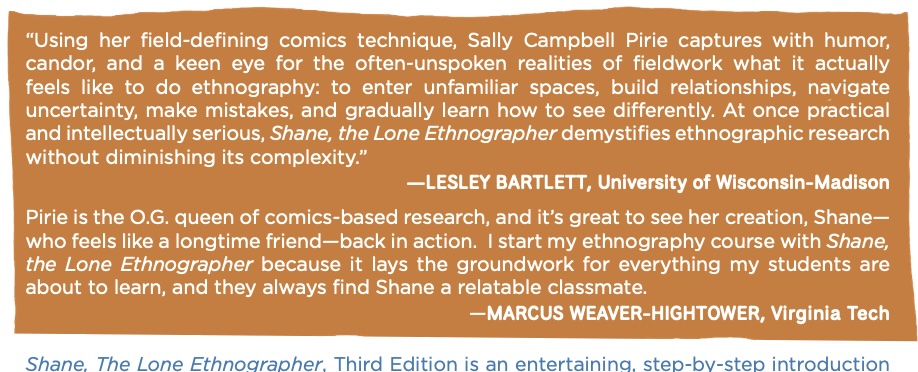
They are two of my heroes, so having earned their good opinion is worth so, so much to me. And while they said lots of nice things about me (never before have I been referred to as the OG Queen of Comics Based Research but I love it and will now require people to address me as such. I will also answer to Your Majesty or Your Eminence. Either one.), I think I should let you all know the many, many nice things about them.

Professor Lesley Bartlett is a scholar who whose contributions to the fields of anthropology and education, as well as comparative and international education, are both beautiful and badass. Her research is widely regarded as foundational, cutting-edge, and methodologically rigorous. Bartlett is widely recognized for her contributions to qualitative research methods, specifically for pioneering the Comparative Case Study (CCS) approach alongside her frequent collaborator, Frances Vavrus. I’ve always loved her work on the “Vertical” Case Study: This methodological framework argues against traditional, static case studies. Instead, she encourages researchers to look at a phenomenon through three axes: horizontal (comparing different locations), vertical (tracing how local experiences connect to national and global policies), and transversal (how the issue shifts over time). Similarly, her work on literacy has contributed to one of the most important epistemological shifts of the contemporary era: Rather than viewing literacy as just a technical skill (reading and writing), Bartlett approaches it as a cultural and social practice deeply tied to power, race, and class. Beyond her stellar publishing record and service as a journal editor, what truly distinguishes Dr. Bartlett is her exceptional commitment to academic community and collaboration. She has a remarkable history of intentionally involving graduate students in her scholarly work, having co-published over 25 articles and chapters alongside her mentees—a testament to her deeply supportive and generative approach to mentorship. On a personal level, Dr. Bartlett possesses an unshakeable work ethic, intellectual generosity, and an inclusive spirit. She inspires those around her to pursue rigorous inquiry while fostering an environment where everyone feels valued and empowered to succeed. Dr. Bartlett represents the very best of higher education leadership and scholarship. And she is funny and kind and a total delight.
Professor Marcus Weaver-Hightower defined the field of research comics, writing some of the most important and poignant texts in the canon and changing how we do scholarship forever. His academic career is distinguished by his deeply interdisciplinary and impactful research. As a former Fulbright Scholar to Australia, he conducted groundbreaking policy analysis regarding the education of boys. His innovative scholarship spans diverse areas, including the politics of school food, masculinity studies, and the pioneering use of comics and graphic novels in qualitative research. His ability to bridge complex social theories with practical educational policy demonstrates a rare and profound intellectual versatility. His academic career is distinguished by his groundbreaking contributions to qualitative methodology, most notably as a pioneer in comics-based scholarship. Through highly influential co-authored works like The Affordances of Comics for Research Across Disciplines and chapters on Creating Comics-Based Research in the Academy, he has helped formalize and legitimize sequential art as a rigorous modality for empirical inquiry. He does not merely theorize this framework; he practices it at the highest level. His piece “Losing Thomas & Ella: A Father’s Story” stands as a seminal example of a ‘research comic’—deploying visual metaphor and structural autoethnography alongside a meticulous methodological appendix to analyze complex trauma and grief. By moving past traditional, purely text-based methodologies, his work provides scholars with the tools to capture structural nuances, navigate ethical representation, and communicate complex social data to broader publics with extraordinary clarity and empathy. Dr. Weaver-Hightower gave me the words to begin to talk about what I do and without him I could not do it. Full stop.
[i] Mann, J. (2015). Towards a politics of whimsy: Yarn bombing the city. Area, 47(1), 60–66.
[ii] Rethman, P. (2021, September 30). The joyful materiality of pink & green, and blue. Fieldsights. https://www.culanth.org/fieldsights/the-joyful-materiality-of-pink-green-and-blue
[iii] Deming, W. E. (2000). The new economics for industry, government, education (2nd ed.). MIT Press.
[iv] https://lilith.org/articles/invention-of-a-feminist-sound-bite/
[v] Weaver-Hightower, M. (2017). Losing Thomas and Ella: A father’s story (a research comic). Journal of Medical Humanities, 38, 215-230.
[vi] Williams, M. (1922). The Velveteen Rabbit. George H. Doran
[vii] https://sallypirie.com/about/

1 thought on “A NEW BOOK STRAIGHT FROM THE OG QUEEN TO ALL OF YOU”