Author: Sally :)

Let’s use comics to analyze qualitative data!

Let’s use comics to analyze qualitative data!

That’s right. It can be done. And it is awesome. Your friendly neighborhood cartoonist and comics-based researcher (CBR) here to tell you how to use the visual arts in general–and comics specifically–to analyze data. That’s what I’m able to share in my chapter, graciously included …

The best award yet.

The best award yet.

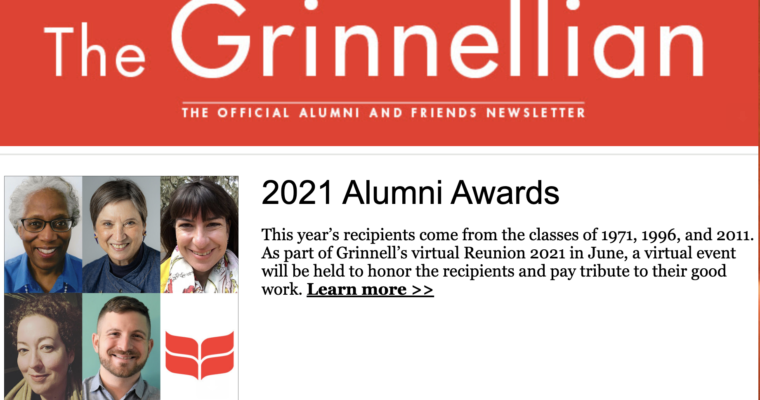
I’ve won a whole bunch of fancy awards over the years, but none of them has been as important, or has made me feel as happy or as humbled, as learning that I am among the recipients of this year’s Grinnell College Alumni Awards. Everything …

On death in preschool

On death in preschool

My newest research article will be appearing in a beautiful special issue of Ethnography and Education, edited by the brilliant and supportive Debbie Albon and Christina Huf. Debbie and Christina and I met at the Ethnography and Education conference at New College, Oxford, held each September (and yes, I miss everyone there terribly here in what may be the second pandemic conference season without being able to travel– like all ethnographers I believe that there is no bloodless zoom substitute for being there, and hope for a return to real life soon). I was so pleased that my article, Nicole’s Mother Is Dead, was accepted for this special issue and gently shepherded through its steady improvement by Debbie and Christina. The whole volume is gorgeous and I encourage everyone to read the included pieces. You can access my contribution here: https://www.tandfonline.com/doi/abs/10.1080/17457823.2020.1861956

My piece, with its rather intentionally provocative title, comes from my preschool ethnography project, during which I spent hundreds and hundreds of hours hanging out in one of the best play-based preschools I have ever had the privilege of observing and, eventually, being a part of. It was a magical three years of work, and I am still going through the rich data from that work. The experience not only informed my deeper understanding of the craft of ethnography of childhood contexts, but also was the foundation for current projects looking and gender in childhood and families. I owe those children and their teachers everything, as childhood researchers always do.

The paper itself is about death, full stop, and builds on theorising from other work, namely, on the idea that we can learn about adults themselves from their reactions, censorial impulses and exclusions around children’s engagements with cultural taboos and contradiction. And rather than being a strange or discordant fit, death is everywhere in preschool. It is natural, but also literally present, from the death of pets to the death of people to death in pretend play or children’s media. And, for children in rural settings, the unexpected deaths that occur every day in the natural world that surrounds them. Death is never pedestrian to the children, even as they laugh and mock it and try to understand it through the work of play, but it is fanned into pearl-clutching by some of the adults around them. And to all of this I must add the usual disclaimer that this work is situated in the US cultural context, with its escalating religious extremism, violence, and paradoxical, empty rhetoric around the value of life. I will never get used to living here, a place where children are murdered in their early years classrooms and tortured at the U.S./Mexico border while legislators profit from their deaths. Ad infinitum.

I’ll let the abstract speak for itself:

This paper presents data from a multi-year ethnography of a rural preschool in the United States in which children engaged in substantial free and structured imaginative play. An unexpected death during the course of the data collection period was followed by a spate of death-related play and storytelling by the children, with varied adult reactions. These analyses explore this death play, problematise the adult responses to ‘inappropriate’ play and stories, and question the sanitised and curated nature of what play – and by extension what children – are valued and valorised in preschool. Implications for how children’s unruly or uncomfortable play is understood and acted upon by adults, and the complex importance of play in early childhood learning contexts, conclude the paper.

Graphic Installation on Carers in HE

Graphic Installation on Carers in HE

Dr. Marie Pierre Moreau and I have perpetrated a delicious graphic installation piece of comics-based/arts-based research focusing on the experiences of carers in higher education. This project has been generously supported by an AdvanceHE Good Practice Grant. We hope to bring the exhibit to locations …

Ghostly Presences Out There

Ghostly Presences Out There

The COVID-19 pandemic has been a horror for the vast majority of us, however it has been particularly nasty for girls and women, who bear the brunt of the social, emotional and economic impacts of the pandemic. This goes doubly for teenage girls. As a …

Coloring Books for All Our Kids

Coloring Books for All Our Kids

As a scholar in childhood, one of the things I struggle with is how after spending so much time with young children and their families, much of the research writing I produce is for a different audience– usually research journals. And let’s face it, most six year olds are not interested in reading my most recent piece in Journal of Things I Learned About Children Presented In Extremely Small Typeface, no matter how low its acceptance rate or how immaculate my research methodology.

So I have been experimenting a bit with that, as one saw in Washing Knives. And I like to work on my child-writing chops a bit when the opportunity arises, so imagine my glee at being asked to synthesize what we know about the needs of children and families’ foster and adoptive experiences into a coloring book! This book is from the nice people at All Our Kids, a non profit organization that supports foster and adoptive families, and the were helpful not only in providing me with data on family experiences, but also helping me understand what normalization of experience could mean for these stakeholders. The result is a very nice illustrated text that seeks to do just that in a developmentally appropriate and research-based way.

And by purchasing the book, you can help All Our Kids with their important work.

it’s not really about washing knives

it’s not really about washing knives

I wrote a piece recently about comics, and art, and method, and disrupting and questioning and hopefully growing the work that we do in the academy. Remember those little capsules that you put in water and they suddenly expand and become a huge sponge dinosaur? …

this is the work

this is the work

A few years ago I wrote a rough, raw little comic called “Research in Pain.” It was so popular it was reprinted in a book called Through the Lens of Cultural Anthropology. Today I got an email from the editor from someone who read the …

Stories of good in the world.

Stories of good in the world.

I owe 99.99999% of who I am and the work I do to the education I received at Grinnell College (’96, English). I went there sight unseen from Honolulu, Hawaii. I didn’t have a warm winter coat, many pairs of socks, or any idea of what I was getting into. I had never been to the midwest before. But I stayed for all four years. And today I found myself in the pages of Grinnell Magazine! I am so pleased.

You can read the whole thing here: http://magazine.grinnell.edu/news/stories-good-world

WTF?!

WTF?!

https://umass-amherst.zoom.us/meeting/register/tJAvcOmvpj8qGtULOnsBXYCozsUxPC5pLEKP